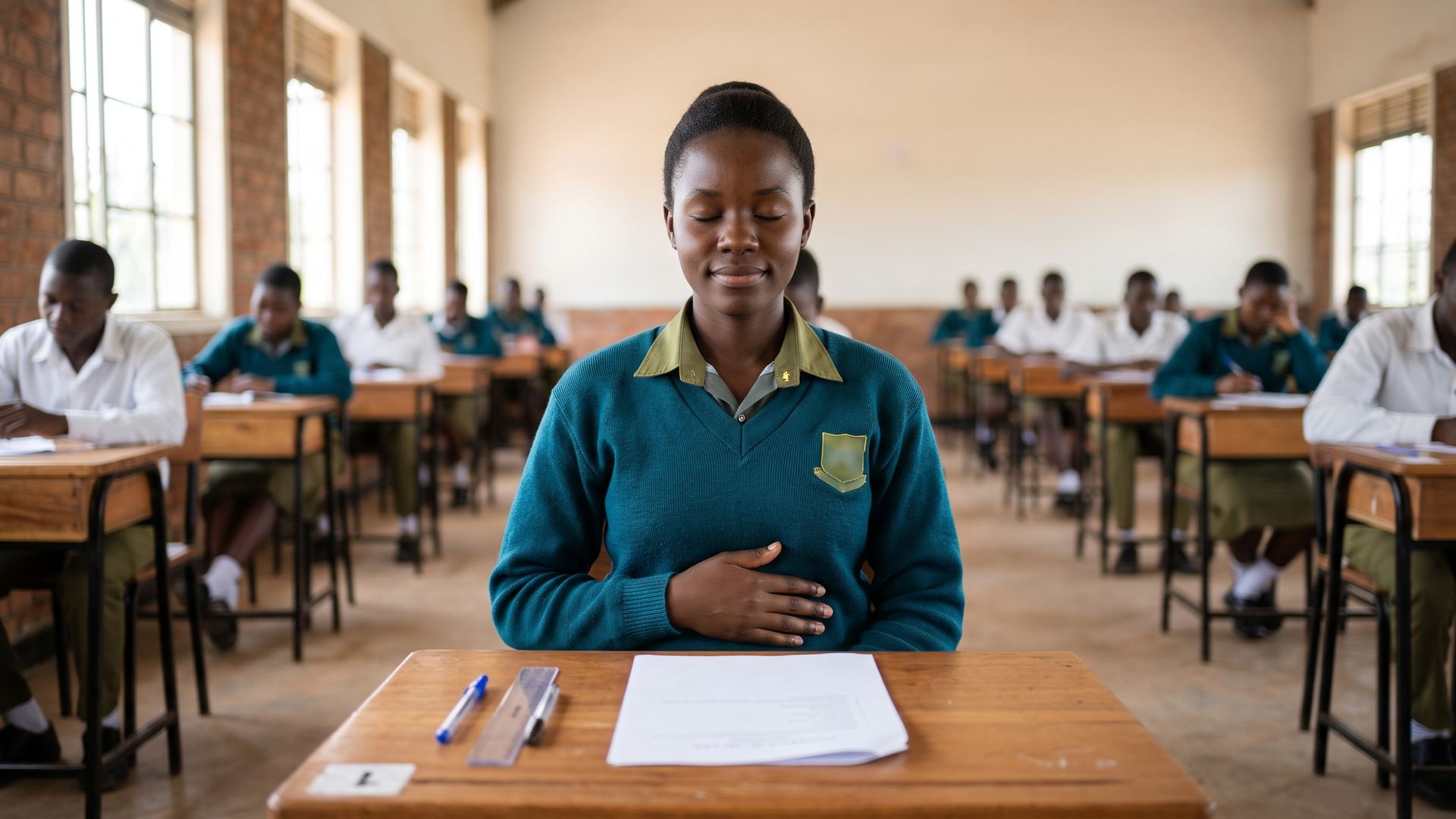
Across Uganda, Senior Four candidates finished their UCE papers on 3 November, and Senior Six candidates are now in the middle of UACE, which runs until early December. For many of them, and for the families waiting at home, this is a season of exam stress. This post explains what exam stress and exam anxiety are, how to spot them, and quick tools a student can use to calm down in minutes, even in the exam room. It also sets out what parents, guardians and schools can say and do to help.
What exam stress is, and when it becomes a problem
Stress is the body’s response to a demand or a challenge. Your heart beats faster, your breathing quickens and your mind sharpens. It is the body getting ready to act.
Anxiety is worry and fear that carries on, often about something that has not happened yet. It can stay even after the challenge has passed.
Exam anxiety (also called test anxiety) is anxiety tied to tests and exams. The worry becomes so strong that it gets in the way of studying, sleeping or showing what you know.
Some pressure is helpful. A little exam stress pushes you to revise, keeps you alert and helps you focus on the paper. UNEB’s own instructions to candidates make the same point: the exam “is not an end in itself”, so candidates “should approach the examination without panic” (UACE 2026 timetable, UNEB).
Pressure becomes harmful when it stops you from functioning: you cannot sleep, cannot eat, go blank in every paper or feel hopeless. A 30-year review of 238 studies found that higher test anxiety is linked to lower exam results, and that high-stakes exams raise anxiety. So calming down is not only about feeling better. It also helps students show what they have learnt.
How exam stress shows
Every student is different, but these are common signs. The NHS lists many of them.
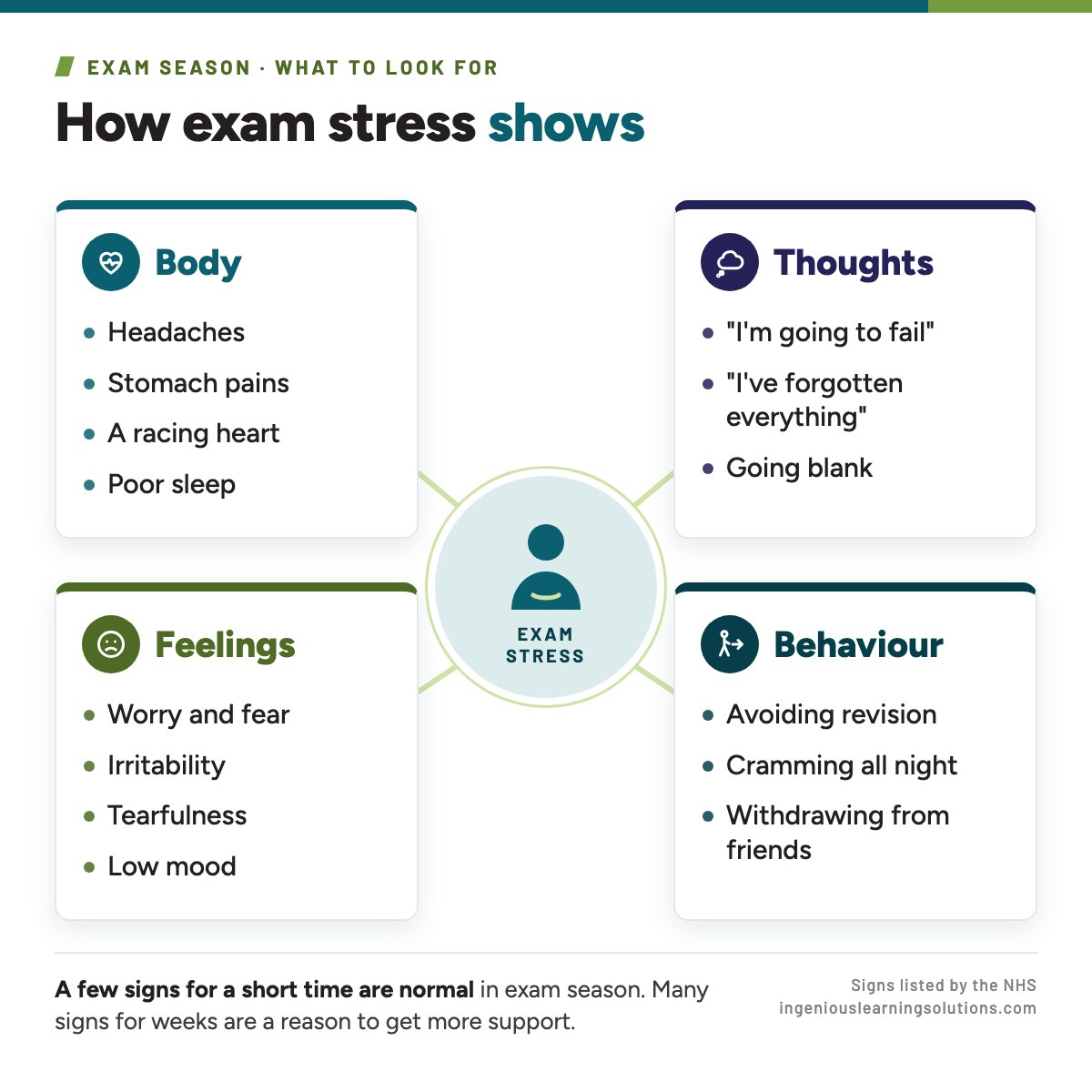
- In the body: headaches, stomach pains, a racing heart, sweaty hands, shaking, tiredness, poor sleep, eating much less or much more.
- In the thoughts: “I’m going to fail”, “I’ve forgotten everything”, “everyone else is ready except me”, going blank, finding it hard to concentrate.
- In the feelings: worry, fear, irritability, tearfulness, low mood, feeling hopeless about the future.
- In behaviour: avoiding revision, cramming all night, withdrawing from friends, losing interest in things they used to enjoy, arguing more at home.
A few of these, for a short time, are normal in exam season. Many of them, for weeks, are a sign to get more support.
Calm down in minutes: tools for students
These tools ease exam stress in a few minutes. Practise them at home first, so they are easy to use when you need them. In the exam room, do them quietly and with your eyes on your own desk. If you ever feel dizzy, stop and breathe normally.
1. Box breathing
Use it before you open the paper, or when your mind goes blank.
- Breathe in through your nose for a count of 4.
- Hold for 4.
- Breathe out slowly for 4.
- Hold for 4.
- Repeat four or five times.
Picture tracing the four sides of a square as you count.
Watch: Box Breathing for Stress (CHI Health, YouTube, about 2 minutes), a guided round to follow along with.
2. Long-exhale breathing
A slow, long breath out tells the body it is safe. If holding your breath is uncomfortable, use this instead.
- Breathe in gently through your nose for a count of 4.
- Breathe out slowly through your mouth for a count of 6 to 8, as if blowing on hot tea.
- Repeat for one or two minutes.
A variation is the 4-7-8 breath: in for 4, hold for 7, out for 8. Another is the double sigh: two short breaths in through the nose, then one long, slow breath out. In a 2023 study, five minutes a day of this exhale-focused breathing improved mood and lowered breathing rate more than mindfulness meditation did. The NHS also offers a simple breathing exercise for stress.
Watch: Dr Andrew Weil showing the 4-7-8 breath (YouTube) · the double sigh, explained by Stanford neuroscientist Andrew Huberman (YouTube) · 4-6 long-exhale breathing (TikTok).
3. The 5-4-3-2-1 grounding exercise
When worry pulls your mind into the future, this brings it back to the room. Silently name:
- 5 things you can see (the desk, your pen, the window…)
- 4 things you can feel (your feet on the floor, the chair, your sleeve…)
- 3 things you can hear
- 2 things you can smell
- 1 slow breath you can take
Watch: 5-4-3-2-1 Grounding Exercise (Self-Help Toons, YouTube, animated) · Coping Skill: 5, 4, 3, 2, 1 Grounding Technique (Stand4Kind, YouTube, voiced by a student).
4. Helpful self-talk
What you say to yourself matters. One study of students sitting a real exam found that those told that a racing heart can help performance scored higher in maths. So try swapping unhelpful thoughts for calm, true ones:
| Instead of… | Try… |
|---|---|
| “I’m going to fail.” | “I have prepared. I will do my best on this question, then the next one.” |
| “I’ve forgotten everything.” | “My mind is busy. When I breathe, things come back. I’ll start with what I know.” |
| “My heart is racing. Something is wrong.” | “My body is getting ready. This energy can help me focus.” |
| “Everyone else is doing better.” | “I can only write my own paper. Eyes on my desk.” |
| “This one paper decides my whole life.” | “This is one paper. There are many paths, and I will find mine.” |
Keep one short phrase ready, such as “Calm, steady, one question at a time.”
5. Muscle release
Stress makes muscles tight without us noticing.
- Squeeze your toes and feet for five seconds, then let go.
- Press your knees together for five seconds, then let go.
- Make fists, then let go.
- Lift your shoulders to your ears, then drop them.
- Notice the difference between tight and loose.
6. Write the worry down
The night before or the morning of a paper, take ten minutes to write your worries on paper, then put it away. Researchers found that students who did this just before an exam performed better, especially the most anxious ones.
Habits that keep exam stress down during the exam weeks
- Sleep. Teenagers need about 8 to 10 hours, according to the NHS. A full night helps memory more than an all-night cram.
- Eat and drink. Eat breakfast, even a small one, and drink water through the day. Go easy on sugary drinks and too much tea or coffee.
- Revise in short blocks. Study for 30 to 45 minutes, then take a 5 to 10 minute break: stretch, walk, drink water.
- Move your body. A short walk or some exercise each day eases tension and helps sleep.
- Skip the post-mortem. After a paper, avoid comparing answers in the corridor. That paper is done. Turn your attention to the next one.
- The night before. Pack your things (pens, ruler, calculator, index number), go over light notes only and sleep at a normal time.
- The morning of the paper. Wake on time, eat, arrive early (UNEB asks candidates to be at the hall at least 30 minutes before the start), and do one round of box breathing before you go in. In the paper, read the instructions twice and start with a question you know.
What parents and guardians can do
Parents are often the biggest source of comfort, and sometimes, without meaning to, a source of exam stress. A few things make a real difference.
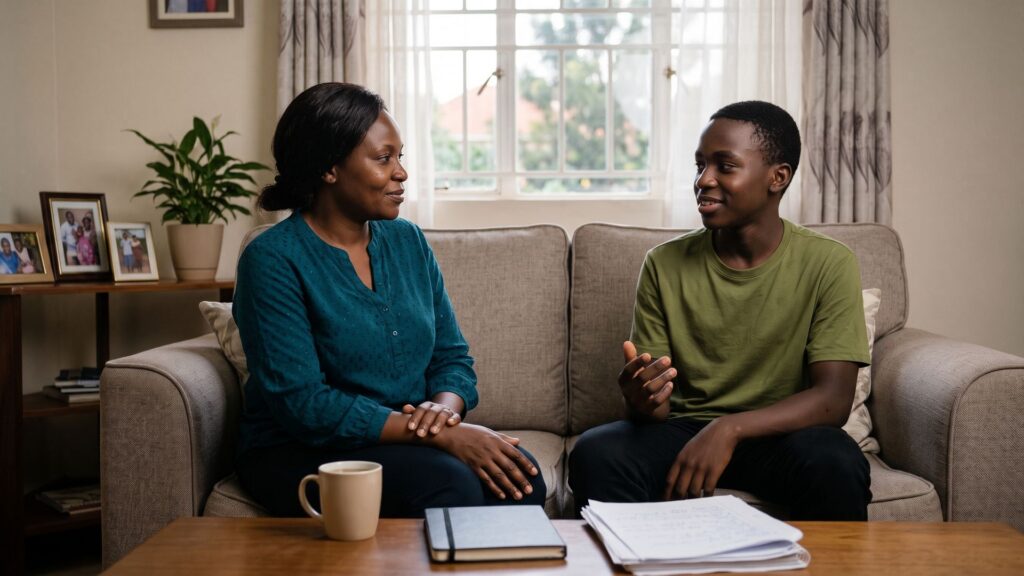
- Keep home calm and routines normal. Regular meals, quiet time for study and fewer chores in the exam weeks.
- Watch sleep and food. Make sure your child eats and goes to bed at a sensible time.
- Listen more than you lecture. Ask how they are feeling, not only how the paper went.
- Praise effort, not only grades.
- Show that your love does not depend on results.
Helpful things to say
- “I’m proud of how hard you’ve worked.”
- “Whatever the results, we will work it out together.”
- “Do you want to talk about it, or shall we take a break?”
- “One paper at a time. You’ve got this.”
Things to avoid saying
- “If you fail, you have wasted my money.”
- “Your cousin got first grade. Why can’t you?”
- “Everything depends on these exams.”
- “Why are you resting? You should be reading.”
It helps to remember how S4 grades now work. Under the competence-based curriculum, the continuous assessment done in school counts for 20 percent of the final UCE grade. One difficult morning is not the whole story.
What schools and teachers can do
Schools set the tone for exam season. Simple steps reduce exam stress and help candidates arrive calm.
- Brief candidates calmly. Explain the rules clearly without threats or fear.
- Teach the calming tools in class before exams start, so students have practised them.
- Name a person that candidates can talk to: a senior woman or senior man teacher, a class teacher or a counsellor.
- Avoid public ranking and shaming after mock exams. Give private, specific feedback instead.
- Plan breaks, meals and water on exam days, especially for boarding candidates.
- Watch for students who are struggling and follow up with them and their families.
- Plan for results day. Decide in advance who will support students who are disappointed.
Our earlier post on school mental health without a full-time counsellor explains how to set up this kind of support in any school, whatever its budget.
After the exams, and when to get help
When the last paper is over, encourage students to rest, see friends and enjoy activities. Waiting for results can bring its own worry. Remind them that there are many routes after S4 and S6: further study, vocational and technical courses, and resits.
Most exam stress fades once the exams end, but not always. Get professional help if a young person:
- cannot sleep, eat or function for more than two weeks;
- has panic attacks, or stays withdrawn and hopeless;
- stops caring for themselves or seeing anyone;
- talks about wanting to die, or about hurting themselves.
If you think a young person may be thinking of suicide or self-harm, act now. Stay with them, listen without judging and get help straight away. Anxiety disorders are common in young people: the World Health Organization estimates that one in seven 10 to 19-year-olds lives with a mental disorder, and that suicide is the third leading cause of death among 15 to 29-year-olds. Help works, and asking for it is a strength.
Where to get help in Uganda
- Sauti 116, the national child helpline run by the Ministry of Gender, Labour and Social Development: dial 116, free, any time of day or night.
- Mental Health Uganda toll-free helpline: 0800 21 21 21 (Monday to Friday, 8:30am to 5:00pm).
- Butabika National Referral Hospital, Kampala: toll-free line 0800 211 306.
- Your nearest health centre or hospital, and the school counsellor or senior woman or senior man teacher.
This post gives general information, not medical advice. If you are worried about a young person, please speak to a health worker or one of the services above.
Supporting your school’s candidates
Through our Educational Consulting work, we run mental health and resilience programmes for schools. We train administrators, teachers and student leaders in practical skills for managing stress and supporting learners, and help schools set up simple systems to spot and follow up on students who are struggling. If you would like to prepare your next candidates for exam season, contact us.
To every S4 and S6 candidate: you have prepared, and you are more than your results. Breathe slowly, take one question at a time, and do your best.